
AMMA
| AMMA
Analyses Multidisciplinaires de la Mousson Africaine |
|---|
Démarré en 2002, AMMA est un programme de recherche international et interdisciplinaire qui étudie la variabilité de la Mousson d’Afrique de l’Ouest et ses impacts sur les populations.
| Coordinateur | Jean-Luc Redelsperger - CNRS | 
logo_AMMA
|
|---|---|---|
| Correspondant CNRM-GAME | Jean Philippe LAFORE | |
| Équipes CNRM-GAME | Bureau exécutif international AMMA | |
| Site Internet du projet | AMMA International | |
| Début | 2002 | |
| Durée | 8 ans, reconduit pour 10 ans |
Objectifs
Les trois objectifs principaux d’AMMA sont de :
- Améliorer notre compréhension de la mousson d’Afrique de l’Ouest et ses influences sur l’environnement régional et global.
- Fournir, dans les questions sociétales, la science fondamentale liée à la variabilité de la MAO pour la définition et la mise en œuvre de stratégies de surveillance et de prévision.
- Garantir que la recherche effectuée dans AMMA est effectivement intégré aux activités de prévisions et de prise de décision.
Apports du CNRM-GAME
Le CNRM accueille depuis 2007 le bureau exécutif international du programme AMMA. Ce pilotage permet une coordination au niveau national, international et africain.
La contribution de Météo-France à travers le CNRM-GAME concerne :
– la participation aux campagnes de terrain
– la participation aux actions de recherche (assimilation, convection, méso-échelle, climat, chimie, aérosols, océan),
– la mise en œuvre de moyens d’observation (ATR42, campagne océanographique Egee-AMMA, VHF)
– et d’une chaîne de prévision spécifique à haute résolution ( 10 km) durant la SOP.
Description du projet
Malgré les incertitudes sur les perspectives du climat régional africain (GIEC 2007) en raison de l’imprécision des modèles actuels sur cette région et de la complexité du climat africain, les impacts de la variabilité climatique sur le continent, en particulier dans la région sahélo-saharienne se font déjà sentir. C’est en effet dans cette région que le plus grand déficit régional de pluie a été observé au siècle dernier. Elle est particulièrement vulnérable en raison des fortes amplitudes de ses variabilités météorologique et climatique, d’une dépendance prépondérante des activités sociétales à ces variabilités, comme l’agriculture pluviale (80% de la population au Sahel en dépend) et de capacités économique et institutionnelle limitées pour faire face et s’adapter aux conséquences.
Des chercheurs d’Afrique, d’Europe et des États-Unis se sont regroupés pour étudier les questions primordiales posées par ces enjeux. La nécessité d’améliorer les prévisions météorologiques et climatiques nécessaires à la mise en place des systèmes d’alerte précoce a motivé la communauté scientifique à définir les trois objectifs majeurs pour AMMA.
Résultats obtenus de la phase 1 d’AMMA
La forte coordination internationale multi-organismes a permis la création d’une communauté de recherche de 600 personnes très impliquées dans laquelle plus de 250 chercheurs africains, regroupés en un réseau AMMA-Afrique, travaillent sur la science d’AMMA.
Grâce à cette coordination internationale, ces équipes dynamiques sont à l’origine des grandes réussites d’AMMA : la parution de 500 publications à comités de lecture dont 10 éditions spéciales, l’organisation de conférences internationales (Dakar 2005, Karlsruhe 2007 et Ouagadougou 2009) réunissant une moyenne de 400 chercheurs, une base de données multi-échelles multidisciplinaires sans précédent utilisée à travers le monde et répliquée en Afrique, la mise en œuvre coordonnée de systèmes d’observation sur le long terme depuis 2001, des campagnes de terrain plus vastes entre 2005 et 2007 avec plusieurs périodes d’observation intense.
Après 8 ans d’activité et en ouverture des 10 ans à suivre, AMMA est aujourd’hui le programme de référence sur le climat et la météorologie en Afrique de l’Ouest. L’ensemble des compétences rassemblées a permis des progrès significatifs sur nos connaissances et notre compréhension des aspects multi-échelles et multi-disciplinaires du système couplé océan-atmosphère-continent de la mousson ouest-africaine.
AMMA a aussi permis de construire les bases scientifiques et une communauté nécessaires pour répondre pleinement aux deuxième et troisième objectifs du programme.
La communauté AMMA, continuellement enrichie par la formation, a engagé près de 160 étudiants en doctorat dont la moitié Africains, 80 thèses sont déjà soutenues dont 28 par des étudiants africains. Trois écoles d’été et quatre ateliers de formation réunissant des étudiants, des chercheurs et des prévisionnistes de l’Afrique et du monde entier ont été un succès. A travers AMMA, de nouveaux masters se mettent en place. AMMA soutient activement l’enseignement et la formation. L’essor considérable de la communication scientifique d’AMMA vers tous ses publics a répondu à une volonté forte du programme pour la diffusion des connaissances et plus particulièrement dans sa participation à la sensibilisation en Afrique.
La seconde phase d’AMMA
Au terme de la 1ère phase d’AMMA, le programme AMMA a été reconduit en 2010 pour une durée de 10 ans. Cette seconde phase en court est présentée dans une page spécifique AMMA-2 de ce site du CNRM-GAME.
Les partenaires
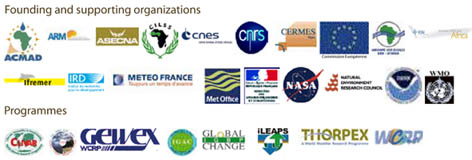
Institutions fondatrices et soutenant AMMA
ACMAD - ARM - ASECNA - CILSS - CNES - CNRS (INSU-INEE) -CERMES - Union Européenne - 2iE - ICSU-RoA - IFREMER - IRD - Météo France - MetOffice - MAE - NASA - NERC - NOAA - WMO
Programmes :
CLIVAR – GCOS – GEWEX – IGAC – IGBP – ILEAPS – THORPEX – WCRP
Avec la participation de :
Algeria : Algérie
– Office National de la Météorologie
Benin : Bénin
– Centre National de Télédétection et de Surveillance du Couvert Forestier
– Direction Générale de l’Eau (DG-Eau)
– Direction de la Météorologie Nationale
– Centre de Recherches Halieutiques et Océanologiques du Bénin (CRHOB)
– Université d’Abomey-Calavi
Burkina Faso :
– Centre National de la Recherche Scientifique et Technologique
– Direction Générale de l’Aviation Civile et de la Météorologie/Direction de la Météorologie
– Direction Générale de l’Hydraulique
– Direction Générale de l’Inventaire des Ressources Hydrauliques
– Institut de l’Environnement et de Recherches Agricoles
– Université de Ouagadougou
Cabo Verde : Cap Vert
– Instituto Nacional de Gestao dos Recursos Hidricos
– Instituto Nacional de Meteorologia e Geofisica
– Instituto Superior de Engenharia e Ciências do Mar
Cameroon : Cameroun
– Centre de Recherches Hydrologiques
– Université de Dschang
– Université de Yaoundé 1
Chad : Tchad
– Direction de la Météorologie Nationale
– Direction des Ressources en Eau et de la Météorologie
– Ministère de l’Environnement et de l’Eau
Congo :
– Université du Congo
Gambia : Gambie
– Global change Research Unit, Department of Water Resources
Ghana : Ghana
– Ghana Meteorological Agency
– Kwame Nkrumah University of Science and Technology
– University of Ghana, Legon
– Hydrological Department
Guinea Bissau : Guinée Bissau
– Serviço Meteorologico Nacional
Guinée Conakry :
– Direction Nationale de la Météorologie de Guinée
– Direction Nationale de l’hydrologie
Ivory Coast : Côte d’Ivoire
– Direction de l’Hydrologie
– Direction de la Météorologie Nationale
– Institut de Géographie Tropicale
– Université de Cocody, Abidjan
– Université de Abobo-Adjamé (Centre de Recherche en Ecologie/Station d’Ecologie de Lamto)
– Centre de Recherches Océanologiques (CRO), Abidjan
– Laboratoire de Physique de l’Atmosphère et de Mécanique des Fluides (LAPA-MF)
Mali :
– Direction Nationale de la Météorologie
– Direction Nationale de l’Hydraulique
– Ecole Nationale d’Ingénieurs
– Institut d’Economie Rurale
– Institut National de Recherche en Santé Publique
– Institut Polytechnique Rural de Katibougou
– Secrétariat Technique Permanent
– Université de Bamako
Marocco : Maroc
– Direction de la Météorologie Nationale
Niger :
– AGRHYMET
– Centre Régional d’Enseignement Spécialisé en Agriculture
– Direction de l’Hydrologie
– Direction de la Météorologie Nationale
– Université Abdou Moumouni, Niamey
Nigeria :
– Federal Ministry of Agriculture
– Federal University of Technology, Akure
– Nigerian Meteorological Agency
– Nigerian Institute for Oceanography and Marine Research(NIOMR)
– Obafemi Awolowo University
– University of Jos
– University of Lagos
Senegal : Sénégal
– Centre d’Études Régional pour l’Améloration de l’Adaptation à la Sécheresse
– Centre de Suivi écologique
– Direction de l’Hydraulique
– Direction de la Météorologie Nationale
– Ecole Supérieure Polytechnique
– Institut Sénégalais de Recherches Agricoles
– Université Cheikh Anta Diop de Dakar
– Centre de Recherches Tropicales de Climatologie en Afrique (CRTCA)
– Laboratoire d’Enseignement et de Recherche en Géomatique (LERG)
– Laboratoire de Physique de l’Atmosphère Siméon Fongang (LPASF)
Togo :
– Direction de la Météorologie Nationale
– Direction Générale de l’Hydraulique et de l’Energie
– Université de Lomé
Belgium : Belgique
– Université Catholique de Louvain
Denmark : Danemark
– University of Copenhagen
Finland : Finlande
– Vaisala OYJ
Germany : Allemagne
– Deutsches Zentrum für Luft-und Raumfahrt
– Forschungszentrum Karlsruhe
– Leibniz-Institut für Meereswissenschaften
– Ludwig-Maximilians-Universität München
– Rheinische Friedrich-Wilhelms-Universität Bonn
– Universität Bremen
– Universität Karlsruhe
– Universität zu Köln
– Leibniz Institüt für Meereswissenschaften - Universität Kiel (IFM-GEOMAR)
Italy : Italie
– Consiglio Nazionale delle Ricerche
– Ente per Nuove Technologie, l’Energia e l’Ambiente
– Universita Degli Studi di Perugia
Netherlands : Pays-Bas
– Koninklijk Nederlands Meteorologisch Instituut
Spain : Espagne
– Universidad de Castilla La Mancha
– Universidad Politécnica de Cartagena
– Universitad Complutense de Madrid
United Kingdom : Royaume Uni
– Centre for Ecology and Hydrology
– Chancellor, Masters and Scholars of University of Cambridge
– Cranfield University
– European Centre for Medium Range Weather Forecasts.
– Imperial College
– Lancaster University
– Ocean Scientific International Ltd
– University College, London
– University of East Anglia
– University of Leeds
– University of Leicester
– University of Liverpool
– University of Manchester
– University of Oxford
– University of Reading
– University of York
– Centre for Ecology and Hydrology (CEH)
– Chancellor Masters and Scholars of the University of Cambridge
– Environment Systems Science Centre (ESSC), University of Reading
– Facility for Airborne and Atmospheric Measurements (FAAM)
United States : Etats Unis d’Amérique
– Brookhaven National Laboratory
– California State University
– Colorado State University
– Columbia University
– Florida State University
– George Mason University
– Howard University
– Massachusetts Institute of Technology
– National Center for Atmospheric Sciences
– Naval Research Laboratory
– SPEC incorporated
– University at Albany
– University Corporation for Atmospheric Research
– University of Connecticut
– University of Cornell
– University of Maryland-Baltimore
– University of Miami
– University of North Dakota
– University of Oklahoma
– University of Utah
– University of Virginia
– Atlantic Oceanic and Meteorological Laboratory (AOML)
– Earth System Research Laboratory (ESRL)
– Hurricane Research Division (HRD)
– National Centers for Environmental Prediction (NCEP)
– National Environmental Satellite, Data and Information Services (NESDIS)
– National Severe Storms Laboratory (NSSL)
– Natural Resource Ecology Laboratory (NREL)